Don’t Risk It: 4 Steps for Safer Capital Equipment Moves

You can’t eliminate risk if you don’t understand where it’s coming from.

That’s why risk assessments in equipment moves are much more than just check-box exercises. They’re about asking the right questions, gathering the right information, and making smart calls at every step.

At IES Inc., we take a tiered approach to risk assessments to ensure nothing is overlooked.

Our General Manager, Tim Patten, explains that approach, and how it helps manufacturers and OEMs move with confidence.

Step 1: Gather as much information as possible

Site survey to gather information ahead of the machinery move

The more you know before a move begins, the better prepared you’ll be to identify hazards and avoid surprises down the line.

“Information gathering has to be first and foremost,” Tim explains. “Gather as much as you can, and check as many boxes as you can upfront.”

According to Tim, that involves: 

  • Walking the site to check access points, floor loads, potential obstacles, and the full route (not just the first door). Think about raised access floors in cleanrooms, point loads near structural columns, or ceiling heights that may be lower than expected around HVAC units.
  • Researching the equipment itself. For example, is it top-heavy? Does it have an off-set center of gravity? Does it have the capacity to draw your fingers in during the commissioning process?
  • Double-checking documentation. Critical details don’t always make it downstream, so you actively need to confirm specs, drawings, and site conditions firsthand.

“The key element is to remember that whatever you’re doing, your risk assessment has to be appropriate to the nature of the work,” Tim adds.

“And that needs to encompass the people, equipment and environment. You can have two identical pieces of equipment going into two different buildings, and you’ll have two different risk assessments.”

Step 2: Assess every step of the move

Access route planning ahead of a machinery move

Once you have the facts, the next step is to look at the move piece by piece to identify specific risks.

“Most people tend to focus on specifics but forget the wider picture,” Tim explains. “So, they might focus so much on how they’re going to move equipment that they forget about risks relating to access or building constraints.”

For example, Tim says, planning to move equipment down a corridor without considering whether you need to block that corridor to stop workers from coming out of offices. Or even planning to move equipment through a live production area without considering how you’re going to mitigate disruption.

That’s why, at every stage, you need to ask questions about the practical realities of the move and how that will unfold in real time. For example: 

  • What lifting equipment will we use, and is it appropriate for the weight and center of gravity?
  • Do we need to close off corridors or re-route people to keep bystanders out of harm’s way? 
  • What’s the specific risk here, and do we have the right controls in place?
  • Do these control measures introduce additional health and safety concerns?

“Having a proper assessment and making sure you’ve got every risk identified and covered is crucial,” Tim concludes.

Step 3. Apply the hierarchy of controls

Machinery safety inspection ahead of a machinery move

Identifying risks is only half the job. You also need a structured way to handle them. 

At IES Inc., we apply the industry-standard hierarchy of control:

  1. Eliminate risks where possible
  2. Reduce them when elimination isn’t realistic
  3. Isolate hazards to keep them contained
  4. Control what remains with safeguards, processes, and PPE

Tim adds, “You might put a control in place to reduce risk in one area, but you also need to think about whether that control has created new risks elsewhere. That’s something lots of teams overlook.”

Finally, applying the hierarchy of controls isn’t just a paper exercise. Every risk assessment is formalized, documented, and shared with all stakeholders (including clients, crews, and subcontractors) to ensure accountability and alignment.

Step 4: Stay flexible when theory doesn’t match reality

Flexible project planning for equipment moves

Even the best plan on paper won’t always match what you find on-site. A corridor could be narrower than expected. A piece of equipment might behave differently than anticipated.

That’s why risk assessments aren’t static. They, by default, have to evolve. 

That makes them tools for ongoing reassessment, rather than one-and-done activities. 

“Don’t be afraid of making changes. Your risk assessment may need several iterations, and you might have to reassess parts of it during the move if reality doesn’t match the plan on paper,” Tim says. “When that happens, step back, review the section, and adjust as needed.”

A good plan is one that supports continuous reassessment so you can adapt and keep moving safely and efficiently.

Move high-technology equipment with total confidence

From single pieces of equipment to entire site relocations, we’re backed by over 30 years of moving capital equipment within high-technology industries.

Find out more about our equipment moves service via our webpage here.

“Never Assume”: 5 Tips for a Smooth Equipment Relocation

In high-technology equipment moves, it’s rarely the big, obvious mistakes that trip you up. It’s the small, overlooked details.

Unchecked floor loading. A missing piece of paperwork. A crate that looked fine on the outside but hid serious damage inside.

Those are the details that can spiral into costly delays, unexpected downtime or serious damage to multimillion-dollar assets.

That’s why the number one rule we’ve learned over decades of supporting manufacturers and OEMs is simple: 

Never assume.

Our general manager, Tim, runs through five proven tips for making sure equipment relocations run smoothly.

1. Gather as much information as possible upfront

Engineers planning an equipment move

A successful relocation starts long before a single piece of equipment is lifted. 

“Everything comes down to planning and communication. It really does,” Tim explains. “That means knowing exactly how you’re going to move the equipment, who’s going to move it, where it’s going to go, how it’s going to be stored and where.”

Even the smallest oversights can cause big issues. For example, assuming a piece of equipment will fit without checking every step of its route. A four-meter unit might slide neatly through the loading bay doors, only to get stuck on a tight 90-degree corner ahead.

That’s why you need every detail upfront. That includes equipment specifications, site conditions, access points, storage requirements, timelines, and even environmental factors like moisture or vibration.

“Try and gather as much information as you can and check as many boxes as you can upfront,” Tim concludes. The more you know in advance, the fewer surprises you’ll face when the move begins.

2. Ask the obvious questions

Never assume every angle has been covered. 

Questions like “Is the site ready?” or “Have we confirmed the access route?” may sound basic, but they can save you days of delays and tens of thousands in unplanned costs.

“You’ve got to ask the right questions, understand the scope and draw out the right information. Even if it feels obvious,” Tim adds.

And remember, what feels obvious to you may not be obvious to your colleagues. It’s far better to risk repeating a question than risk the entire move.

3. Flag anything that doesn’t look right

It’s often the little things that snowball into major problems. A missing piece of paperwork. A crate with a faint scuff mark. A shock indicator that’s triggered. A clearance that looks uncomfortably tight.

Ignore these signs, and you’re setting yourself up for bigger trouble down the line.

Flagging issues isn’t just about protecting the equipment. It’s about protecting your project timeline, budget, and reputation.

“For example, if you’re using a carrier for transport, you need to make sure you’re doing your cargo reports, checking for damage, checking for signs like shock watches, indicators, visible damage on the crates,” Tim explains. “And if you find something, you need to raise the flag straight away.”

4. Go looking for information, don’t wait for it

Engineer project planning

Critical details won’t always fall into your lap.

And if you’re waiting for someone to hand you the right drawings, risk assessments, or site readiness reports, you’re already behind.

“A common mistake I hear is: ‘They didn’t give me the information.’ And I say, ‘Well, did you ask?’ If someone doesn’t tell you exactly what they’re expecting, or they don’t tell you a pertinent piece of information, you can’t plan for it,” Tim says. “And anything you do which isn’t planned, the cost goes up.”

Proactive teams instead seek information out. They ask, they check, they double-check. Because the cost of waiting is always higher, with last-minute scrambles, equipment delays, and firefighting under pressure.

5. Trust your instincts

When you’re standing on-site, surrounded by colleagues, equipment, and deadlines, it can be tempting to override your gut. 

But if something feels off, whether it’s the load balance on a lift, the way a piece of kit is crated, or the flow of people around the move, pause and question it.

Sometimes instinct is your most reliable tool. 

It’s built on experience, the subtle cues you’ve picked up from hundreds of jobs, the lessons you’ve learned from what went wrong in the past. And acting on it can be the difference between a seamless relocation and a huge setback.

“If something doesn’t look right, it probably isn’t. So question it,” Tim concludes.

Move high-technology equipment with total confidence

From single pieces of equipment to entire site relocations, we’re backed by over 30 years of moving capital equipment within high-technology industries.

Find out more about our equipment moves service via our webpage here.

Best Practices for Moving and Installing Printing Presses to Ensure a Smooth, Efficient, and Damage-Free Relocation

Relocating and installing an industrial printing press is a complex task that requires precise planning, expert coordination, and specialized equipment handling. Whether you’re moving a press within your facility, installing a brand-new system, or relocating an entire production line, proper execution is critical to minimizing downtime and ensuring optimal performance.

At Integrated Equipment Services (IES), we have extensive experience managing printing press moves and installations for leading manufacturers and end-users. In this blog, we’ll outline the best practices that help ensure a seamless, efficient process while protecting your valuable equipment.

Detailed Pre-Planning & Site Assessment

A successful printing press relocation or installation starts long before the first piece of equipment is moved. Proper planning and site assessment are key to avoiding costly delays and minimizing operational disruptions.

Key Considerations:

  • Space & Structural Requirements – Ensure the new location can accommodate the press, including clearance for rigging and assembly.
  • Weight Distribution & Floor Load Capacity – Industrial presses are extremely heavy, so verifying the structural integrity of the floor is crucial.
  • HVAC & Electrical Needs – Assess whether the existing HVAC, power supply, and ventilation systems meet the machine’s operational requirements.
  • Route Mapping & Logistics – Plan the exact movement path, identifying potential obstacles such as narrow doorways, overhead obstructions, or tight corners.

A professional machinery moving team will conduct a full site inspection and work with engineers and facility managers to ensure every detail is accounted for before moving day.

Choosing the Right Equipment & Rigging Techniques

Moving a multi-ton printing press requires specialized rigging, lifting, and transportation methods. Using the wrong equipment can lead to damage, misalignment, or even safety hazards.

Essential Equipment for Press Moves:

✔ Industrial Forklifts & Cranes – Used for lifting and positioning heavy press components.

✔ Air Skates & Heavy-Duty Dollies – Allow smooth movement over factory floors.

✔ Custom Rigging Solutions – Including slings, spreader bars, and lifting frames designed for printing press weight distribution.

✔ Shock-Absorbing Transport Vehicles – Reduce vibrations and protect sensitive machine components.

Every press installation is unique, and a professional machinery mover will determine the best approach based on size, weight, and factory layout.

Safe Disassembly & Transport

Before a press can be relocated, it often needs to be partially or fully disassembled. This is a delicate process requiring detailed knowledge of the equipment’s mechanical, electrical, and pneumatic systems.

Disassembly Best Practices:

  • Follow Manufacturer Guidelines – Every printing press has specific disassembly requirements; adhering to these prevents damage.
  • Label & Document Everything – Proper labeling of cables, hoses, and components ensures smooth reassembly.
  • Use Protective Packing – Sensitive parts such as printheads, rollers, and electronic control panels should be packed securely to prevent damage.
  • Ensure Compliance with Safety Regulations – This includes locking out power sources and ensuring no residual ink or hazardous materials remain in the system.

During transport, shock absorbers, climate control measures, and proper bracing help protect the press from vibration and temperature fluctuations that could affect alignment and functionality.

Precision Installation & Alignment

Reassembling and installing a printing press is just as critical as moving it. Even slight misalignment can lead to print quality issues, increased wear on machine components, and frequent maintenance problems.

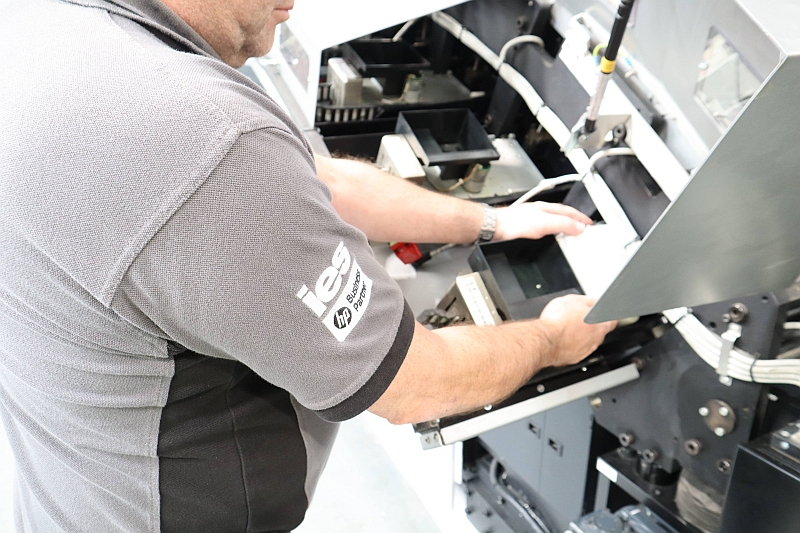
IES Print Engineer at Work

Key Installation Steps:

  1. Positioning the Main Frame & Modules – Using laser alignment tools, each module must be positioned with precision.
  2. Reconnecting Electrical & Pneumatic Systems – Proper reconnection of power, compressed air, and ink delivery systems ensures operational stability.
  3. Calibrating & Leveling the Press – Machines must be perfectly level and trammed to avoid print misregistration and excessive wear.
  4. Integrating with Facility Systems – Ensuring seamless connection to HVAC, dust extraction, and ink supply.

Final Inspection & Testing

Once installation is complete, thorough system checks, test prints, and load testing must be performed. This step ensures that:

✔ Registration, ink flow, and drying systems are functioning correctly.

✔ The press meets quality and speed expectations.

✔ Operators are trained on safe operation and troubleshooting.

Minimizing Downtime & Maximizing Efficiency

Every hour of downtime in a printing facility translates to lost revenue. A well-executed move or install minimizes production delays and maximizes efficiency.

Ways to Reduce Downtime:

✅ Work with an Experienced Machinery Moving Team – Experts like IES ensure smooth coordination and execution.

✅ Schedule Moves During Off-Peak Hours – Minimizing disruption to production schedules.

✅ Use Parallel Workflows – Where multiple teams handle rigging, disassembly, and site preparation simultaneously.

✅ Perform Dry Runs Before Full Production – Running test jobs helps detect any misalignments or errors before going live.

By planning every phase carefully, facilities can return to full production faster while ensuring the press operates at peak efficiency.

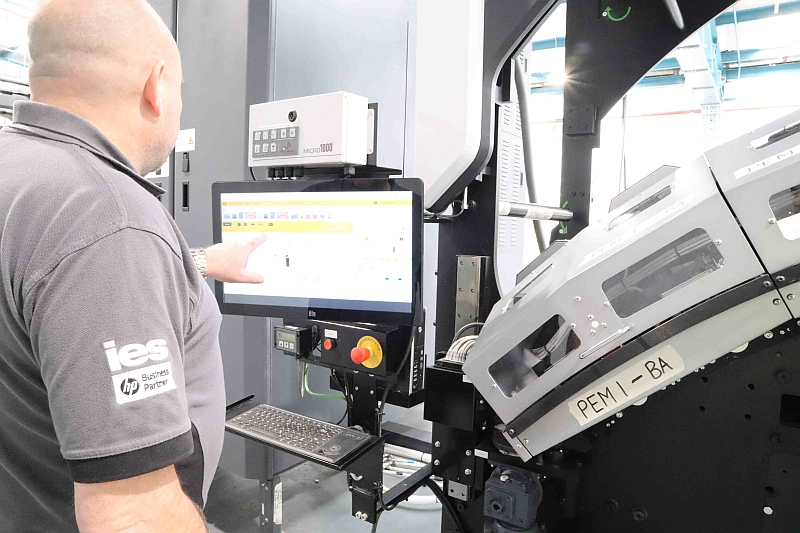
IES Print Engineer operating Computer Controls

Conclusion

Moving and installing an industrial printing press is a highly specialized task that requires detailed planning, expert handling, and precise execution. By following best practices—including thorough site assessment, proper disassembly, specialized rigging, precise installation, and comprehensive testing—companies can ensure a smooth transition with minimal downtime.

At Integrated Equipment Services (IES), we specialize in printing press relocations, installations, and maintenance. Our team has successfully moved and installed some of the most advanced industrial printing equipment across the U.S.

Need Expert Help with Your Next Printing Press Move?

Contact Integrated Equipment Services (IES) today to discuss your project and learn how we can provide a seamless, efficient installation or relocation.

📞 Call us at +1 (781) 428-9502

📧 Email us